World State caste system
Brave New WorldThe World State caste system is a form of social engineering that assigns people to ranked groups, calibrates their abilities and numbers to anticipated needs, and trains them to accept their place as a source of contentment. From the sorting of embryos to the repeated lessons of childhood and the organization of adult labor, it turns hierarchy into both a production plan and an inner conviction. Its central paradox is that a society proclaiming stability and happiness preserves them by restricting choice and distributing unequal lives as though each were precisely suited to its recipient.
Classification and Production
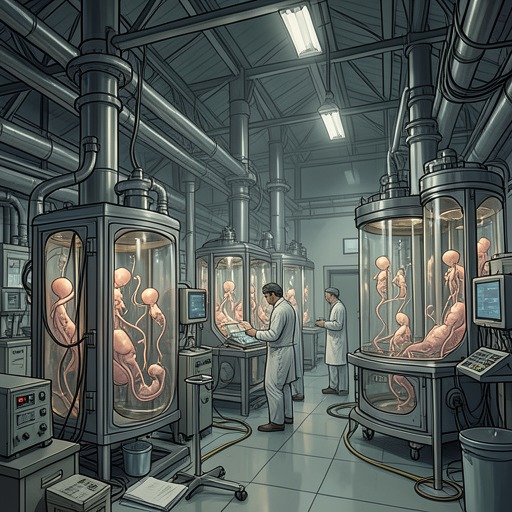
The system begins before birth, with the conversion of biological material into administratively legible people. In the Hatchery, eggs move from test tubes into larger bottles; their heredity, fertilization date, and membership in a Bokanovsky Group are transferred onto labels. The passage from anonymous egg to identified bottle marks the point at which each developing individual becomes part of a planned population.
That population is managed through an extensive information system. The Social Predestination Room contains eighty-eight cubic metres of card-index, updated every morning and coordinated every afternoon. Predestinators calculate how many individuals of each quality are needed and set an optimum rate of decanting; their figures go to the Fertilizers, who supply the embryos requested. Bottles are then predestined in detail. Population planning is therefore not an abstract doctrine: it is a daily exchange of forecasts and biological production, with unforeseen losses made good so that the planned supply can continue.
The production logic extends into factories, where work is organized around groups of near-identical workers. In a helicopter-lighting factory, a single Bokanovsky Group carries out each process as far as possible. Eighty-three Deltas cold-press, fifty-six Gammas operate turning machines, and 107 Epsilons work in the foundry; other caste groups cut screws, assemble dynamos, inspect mechanisms, pack them, and load them for transport. The workforce is presented in exact numbers and repeated physical types, making the factory floor look like the social plan rendered visible. The system does not merely fill jobs with available workers: it breeds and conditions groups to make labor predictable and interchangeable.
Training Hierarchy into Common Sense
Biological assignment is sustained by instruction that teaches people how to interpret the hierarchy. In a recorded sleep lesson, a Beta child says that Alphas wear grey and are clever, while Gammas wear green, Deltas khaki, and Epsilons black. The lesson couples clothing and caste identity with judgments of ability and worth: the child is taught to be glad to be a Beta, to regard harder Alpha work as fitting Alpha intelligence, and to avoid lower-caste children as inferior companions.
The Director describes this process through an image of liquid sealing wax: repeated suggestions adhere, accumulate, and eventually cover the mind like a scarlet coating over rock. The repetitions do not simply transmit facts about social ranks. They become the assumptions through which children—and later adults—judge, desire, and decide. Because the lessons are the State’s own suggestions, the system’s political achievement is to make a designed order feel like an individual’s self-evident understanding.
The same training directs desire toward the economy that the caste system serves. Nursery voices teach children to love flying and new clothes, while repeated lessons make discarding old clothes preferable to mending them. These consumer habits connect early conditioning to the maintenance of industrial demand: children learn not only what social group they belong to, but how to participate in the cycle of production and consumption that supports the whole arrangement.
A hypnopaedic proverb, “But every one belongs to every one else,” gives the system a similarly social formula for personal conduct. The Controller explains that exclusive attachments concentrate impulse and energy, whereas the prescribed norm spreads them across the community. Lenina’s four-month involvement with Henry is treated by Fanny as an unusually long attachment, and she warns that the Director would object to anything intense or prolonged. The episode shows how the ideal of stability reaches into private relationships: even intimate conduct is measured against a rule that discourages enduring exclusiveness.
Stability, Labor, and Managed Happiness
The Controller presents stability as the condition on which civilization depends, linking social stability to the stability of individuals. His account of the turning machine gives the doctrine a material consequence: production must continue without interruption, because stopping the wheels would endanger the population and bring mass starvation. The system therefore requires people steady enough to tend the machinery, and it treats their obedience and contentment as practical necessities rather than incidental virtues.
The caste hierarchy supplies that steadiness by matching labor to trained capacity. When John asks why the State does not make everyone an Alpha Double Plus, Mustapha Mond answers that a society of Alphas would be unstable and miserable. An Alpha conditioned for responsibility and choice would not endure Epsilon work without going mad or smashing things; an Epsilon, by contrast, has been conditioned to find such work the line of least resistance. The Controller describes conditioning as rails laid down for a person to run along and as an invisible bottle that remains around each individual after decanting. The image makes clear that the system’s restrictions are psychological as well as occupational: caste determines the range of conditions within which a person can experience a life as bearable.
Mond argues that lower-caste workers are happier than people above them, even while acknowledging the simplicity of their work. They perform seven and a half hours of mild labor and then receive soma, games, unrestricted copulation, and the feelies. A four-hour working day had been tried in Ireland, he says, but the resulting leisure produced unrest and increased soma consumption rather than greater happiness. In his account, reducing work is not automatically liberating, because the population has been conditioned to find unstructured free time difficult to bear. Leisure, like labor, is administered according to the State’s calculation of what people can tolerate.
The same calculation limits technological change. The State could reduce lower-caste hours or synthesize all its food, but it chooses not to: shorter hours might cause discontent, while replacing agricultural labor would unsettle established arrangements. Mond says every change threatens stability and describes pure science as potentially subversive, something that must be kept under control. The apparent generosity of the system—work suited to capacity, provision of entertainment, and relief through soma—thus belongs to a wider policy of managing both production and the desires that might otherwise question it.
The System’s Limits and Significance
John’s question about universal Alpha status exposes the logic beneath the claim that everyone has been fitted to a happy life. Mond does not say that all castes have equal freedom but different tasks; he argues that the capacities and conditioning needed for different tasks are incompatible. An all-Alpha society would be unable to maintain the division of labor, while lower-caste workers are made to accept their sacrifices because those sacrifices have been built into their expectations. The system presents unequal possibilities as natural differences, then cites the contentment produced by conditioning as evidence that the arrangement works.
Its administrative precision and its emotional assurances reinforce one another. Card-indexes and population calculations determine how many workers of each quality will exist; caste-specific conditioning shapes what those workers will accept; consumer lessons and standardized recreation channel time and appetite; and the language of happiness recasts constraint as care. That coherence is also the system’s weakness as a moral argument. The claim that each person is content does not establish that the conditions are freely chosen, especially when the State has organized the very desires by which contentment is measured.
The caste system is therefore the World State’s method of turning hierarchy into a self-reproducing social order. Its bottles, labels, records, factory groups, and lessons connect reproduction to production and production to belief. The more completely the social plan is absorbed as common sense, the less visible its coercion becomes: people are not merely assigned different work, but taught to regard their allotted limits as the shape of a good life.